 |
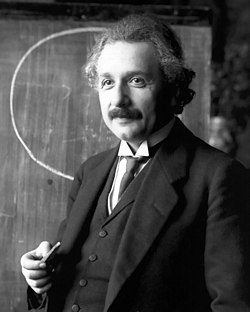
Albert Einstein
The General Theory of Relativity was published in 1915, ten years after the special theory of relativity was created. According to the general theory of relativity, the gravitational attraction between masses results in the masses in space and time, meaning that every object is attracted to each other, and that results in space and time. Einstein's general relativity also explained spacetime. Spacetime is the fact that we have a four-dimensional universe, having three spatial(space) dimensions, and one temporal(time) dimension. All physical objects – us, the moon, the sun, the Milky Way, everything, is located inside these three dimensions. Also, mass causes the shape of spacetime to change, making it curved. All things follow these curves. Black holes are a major source of gravitational waves. A black hole is an object in the universe that has such a strong pull of gravity, that not even light can escape it. They are formed when giant stars, at least three times the size of our sun, dies. This is called a supernova. Also, general relativity explains gravitational lensing, which is where light bends when a massive object comes near it. This was proven during a solar eclipse, when the sun's bending of starlight from distant stars could be measured because of the darkness of the eclipse. General relativity also set the stage for the theory of the formation of our universe. This theory is called the Big Bang. General relativity explained singularities, which is what scientists think the universe formed from. This singularity was small, dense, and very hot. All of the matter that we know today came out of this point 15 billion years ago.
Albert Einstein (14 March 1879 – 18 April 1955) was one of the most famous scientists of the 20th century.
He received the Nobel Prize in Physics in 1921. His theories of special and general relativity are of huge importance to many branches of physics and astronomy. They have been verified by many experiments and observations.
Einstein is famous for his theories about light, matter, gravity, space, and time.
His most famous equation is E = mc2. It means that energy and mass are different forms of the same thing.
Einstein published more than 300 scientific papers and over 150 non-scientific works. He received honorary doctorate degrees in science, medicine and philosophy from many European and American universities.
He received the Nobel Prize in Physics in 1921. His theories of special and general relativity are of huge importance to many branches of physics and astronomy. They have been verified by many experiments and observations.
Einstein is famous for his theories about light, matter, gravity, space, and time.
His most famous equation is E = mc2. It means that energy and mass are different forms of the same thing.
Einstein published more than 300 scientific papers and over 150 non-scientific works. He received honorary doctorate degrees in science, medicine and philosophy from many European and American universities.
On the eve of World War II, he helped alert President Franklin D. Roosevelt that Germany might be developing an atomic weapon, and recommended that the U.S. begin nuclear research. That research, begun by a newly established Manhattan Project, resulted in the U.S. becoming the first and only country to possess nuclear weapons during the war. He taught physics at the Institute for Advanced Study at Princeton, New Jersey, until his death in 1955.
***********************************************************************************************************************************
Stephen Hawking
 |
| कॅप्शन जोडा |
Stephen Hawking was born on 8 January 1942 to Dr. Frank Hawking, a research biologist, and Isobel Hawking. Though Hawking's parents were living in North London, they moved to Oxford while his mother was pregnant with Stephen, desiring a safer location for the birth of their first child. (London was under attack at the time by the Luftwaffe.) According to Hawking, a German V-2 missile struck only a few streets away.
After Hawking was born, the family moved back to London. His father headed the division of parasitology at the National Institute for Medical Research. From the age of eleven, he attended St Albans School, where he was a good, but not exceptional, student. When asked later to name a teacher who had inspired him, Hawking named his mathematics teacher Dikran Tahta.He maintains his connection with the school, giving his name to one of the four houses and to an extracurricular science lecture series. He has visited it to deliver one of the lectures and has also granted a lengthy interview to pupils working on the school magazine, The Albanian.
Hawking was always interested in science. Inspired by his mathematics teacher, he originally wanted to study the subject at university. However, Hawking's father wanted him to apply to University College, Oxford, where his father had attended. As University College did not have a mathematics fellow at that time, it would not accept applications from students who wished to read that discipline. Hawking therefore applied to read natural sciences, in which he gained a scholarship. Once at University College, Hawking specialised in physics. His interests during this time were in thermodynamics, relativity, and quantum mechanics. His physics tutor, Robert Berman, later said in The New York Times Magazine:
It was only necessary for him to know that something could be done, and he could do it without looking to see how other people did it. [...] He didn't have very many books, and he didn't take notes. Of course, his mind was completely different from all of his contemporaries.
Hawking was passing, but his unimpressive study habitsresulted in a final examination score on the borderline between first and second class honours, making an "oral examination" necessary. Berman said of the oral examination:
And of course the examiners then were intelligent enough to realize they were talking to someone far more clever than most of themselves.
After receiving his B.A. degree at Oxford in 1962, he stayed to study astronomy. He decided to leave when he found that studying sunspots, which was all the observatory was equipped for, did not appeal to him and that he was more interested in theory than in observation. He left Oxford for Trinity Hall, Cambridge, where he engaged in the study of theoretical astronomy and cosmology.
Losing an old bet
Hawking was in the news in July 2004 for presenting a new theory about black holes which goes against his own long-held belief about their behaviour, thus losing a bet he made with Kip Thorne and John Preskill of Caltech. Classically, it can be shown that information crossing the event horizon of a black hole is lost to our universe, and that thus all black holes are identical beyond their mass, electrical charge and angular velocity (the "no hair theorem"). The problem with this theorem is that it implies the black hole will emit the same radiation regardless of what goes into it, and as a consequence that if a pure quantum state is thrown into a black hole, an "ordinary" mixed state will be returned. This runs counter to the rules of quantum mechanics and is known as the black hole information paradox.
Human spaceflight
At the fiftieth anniversary of NASA in 2008, Hawking gave a keynote speech on the final frontier exhorting and inspiring the space technology community on why we (the human race) explore space.
At the celebration of his sixty-fifth birthday on 8 January 2007, Hawking announced his plan to take a zero-gravity flight in 2007 to prepare for a sub-orbital spaceflight in 2009 on Virgin Galactic's space service.
In an interview with The Daily Telegraph, he suggested that space was the Earth's long term hope. He continued this theme at a 2008 Charlie Rose interview.
Illness
Stephen Hawking is severely disabled by a motor neurone disease known as amyotrophic lateral sclerosis (ALS). Hawking's illness is markedly different from typical ALS because if confirmed Hawking's case would make for the most protracted case ever documented. A survival for more than ten years after diagnosis is uncommon for ALS; the longest documented durations, other than Hawking's, are 32 and 39 years and these cases were termed benign because of the lack of the typical progressive course.
When he was young, he enjoyed riding horses. At Oxford, he coxed a rowing team, which, he stated, helped relieve his immense boredom at the university. Symptoms of the disorder first appeared while he was enrolled at University of Cambridge; he lost his balance and fell down a flight of stairs, hitting his head. Worried that he would lose his genius, he took the Mensa test to verify that his intellectual abilities were intact. The diagnosis of motor neurone disease came when Hawking was 21, shortly before his first marriage, and doctors said he would not survive more than two or three years. Hawking gradually lost the use of his arms, legs, and voice, and as of 2009 has been almost completely paralysed.
During a visit to the research centre CERN in Geneva in 1985, Hawking contracted pneumonia, which in his condition was life-threatening as it further restricted his already limited respiratory capacity. He had an emergency tracheotomy, and as a result lost what remained of his ability to speak. He has since used an electronic voice synthesiser to communicate.
The DECtalk DTC01 voice synthesiser he uses, which has an American English accent, is no longer being produced. Asked why he has still kept it after so many years, Hawking mentioned that he has not heard a voice he likes better and that he identifies with it. Hawking is said to be looking for a replacement since, aside from being obsolete, the synthesiser is both large and fragile by current standards. As of mid 2009, he was said to be using NeoSpeech's VoiceText speech synthesiser.
In Hawking's many media appearances, he appears to speak fluently through his synthesiser, but in reality, it is a tedious drawn-out process. Hawking's setup uses a predictive text entry system, which requires only the first few characters in order to auto-complete the word, but as he is only able to use his cheek for data entry, constructing complete sentences takes time. His speeches are prepared in advance, but having a live conversation with him provides insight as to the complexity and work involved. During a TED Conference talk, it took him seven minutes to answer a question.
He describes himself as lucky despite his disease. Its slow progression has allowed him time to make influential discoveries and has not hindered him from having, in his own words, "a very attractive family." When his wife, Jane, was asked why she decided to marry a man with a three-year life expectancy, she responded, "Those were the days of atomic gloom and doom, so we all had a rather short life expectancy." On 20 April 2009, Cambridge University released a statement saying that Hawking was "very ill" with a chest infection, and was admitted to Addenbrooke's Hospital. The following day, it was reported that his new condition is "comfortable" and he should make a full recovery from the infection
Awards and honours
1975 Eddington Medal
1976 Hughes Medal of the Royal Society
1979 Albert Einstein Medal
1981 Franklin Medal
1982 Order of the British Empire (Commander)
1985 Gold Medal of the Royal Astronomical Society
1986 Member of the Pontifical Academy of Sciences
1988 Wolf Prize in Physics
1989 Prince of Asturias Awards in Concord
1989 Companion of Honour
1999 Julius Edgar Lilienfeld Prize of the American Physical Society
2003 Michelson Morley Award of Case Western Reserve University
2006 Copley Medal of the Royal Society
2008 Fonseca Prize of the University of Santiago de Compostela
2009 Presidential Medal of Freedom, the highest civilian honour in the United States
***********************************************************************************************************************************
Marie Curie
Marie Skłodowska–Curie (7 November 1867 – 4 July 1934) was a physicist and chemist. She was from Poland but lived in France. She was an expert in the field of radioactivity. She was also the first woman to win a Nobel Prize.[1] She was the first woman professor at the University of Paris as well as the first person to win two Nobel Prizes.[1] She received their Nobel Prize in physics for her research on spontaneous radiation which was discovered by Henri Becquerel.[2]
She was born with the name Maria Skłodowska in Warsaw, Poland. She lived there until she was 24. At the age of twelve, her mother died, and two years earlier, her sister Zofia died. In 1891, she followed her older sister, Bronisława, to study in Paris. In Paris, she got higher degrees. She also did her important scientific work. She founded the Curie Institutes in Paris and Warsaw. Her husband, Pierre Curie, daughter, Irène Joliot-Curie, and son-in-law, Frédéric Joliot-Curie, also won Nobel Prizes.
Curie did many great things. She created a theory of radioactivity (a term made by her and Pierre), found different ways for separating radioactive isotopes, and discovered two new elements, radium and polonium. It was also under her own direction that the world's first studies were used into the treatment of cancers. These treatments used the radioactive isotopes.
While being a French citizen, she never lost her Polish identity. She named the first new chemical element that she discovered (1898) "polonium". This was named after her home country, Poland. In 1932, she founded a radium institute in her home town, Warsaw. It was run by her sister, Bronisława.
 Nobel prize
In 1903 the Royal Swedish Academy of Sciences awarded Pierre Curie, Marie Curie and Henri Becquerel the Nobel Prize in Physics, "in recognition of the extraordinary services they have rendered by their joint researches on the radiation phenomena discovered by Professor HenriBecquerel
."
Curie and her husband were unable to go to Stockholm to receive the prize in person, but they shared its financial proceeds with needy acquaintances, including students.[18]
On receiving the Nobel Prize, Marie and Pierre Curie suddenly became very famous. The Sorbonne gave Pierre a professorship and permitted him to establish his own laboratory, in which Curie became the director of research.
In 1897 and 1904, respectively, Curie gave birth to their daughters, Irène and Ève Curie. She later hired Polish governesses to teach her daughters her native language, and sent or took them on visits to Poland.[31]
Curie was the first woman to be awarded a Nobel Prize. Eight years later, in 1911, she received the Nobel Prize in Chemistry, "in recognition of her services to the advancement of chemistry by the discovery of the elements radium and polonium, by the isolation of radium and the study of the nature and compounds of this remarkable element."
A month after accepting her 1911 Nobel Prize, she was hospitalized with depression and a kidney ailment.
Curie was the first person to win or share two Nobel Prizes. She is one of only two people who have been awarded a Nobel Prize in two different fields, the other person being Linus Pauling (for chemistry and for peace). Nevertheless, in 1911 the French Academy of Sciences did not elect her to be a member by two votes. Elected instead was Édouard Branly, an inventor who had helped Guglielmo Marconi develop the wireless telegraph.[32] It would be a doctoral student of Curie, Marguerite Perey, who would become the first woman elected to membership in the Academy – over half a century later, in 1962.

