Gamma rays
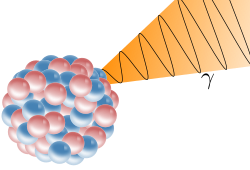
Gamma rays (γ-rays) are electromagnetic waves with the smallest wavelengths in the electromagnetic spectrum.[ They were discovered in 1900 by Paul Villard, and named in 1903 by Ernest Rutherford.
Gamma rays are produced by some types of radioactive atoms. Gamma rays are like x-rays. Both gamma rays and x-rays are photons with very high energies. Gamma rays are also a type of radiation. Gamma rays can travel through thick materials.
Cobalt-60 and potassium-40 are two isotopes that emit gamma rays. Cobalt-60 is created in accelerators and is used in hospitals. Potassium-40 occurs naturally. Small amounts of potassium-40 are in all plants and animals. Gamma rays from potassium-40 each have an energy of 1460 thousand electron volts (keV).
Gamma rays and X-rays are now usually distinguished by their origin: X-rays are emitted by electrons outside the nucleus, while gamma rays are emitted by the nucleus.
Gamma rays in medicine
Gamma rays can also go through the skin to kill cells, such as cancerous cells. Doctors can use machines which produce gamma rays inhospitals to treat people with some types of cancer.
Doctors also use gamma rays to find disease. In hospitals, doctors can give patients radioactive medicine which emits gamma rays. Doctors can find some types of disease by measuring gamma rays which come from a patient afterward. You can also use Gamma Rays to clean Hospital material.

The Moon as seen by the Compton
Gamma Ray Observatory, in gamma
rays of greater than 20 MeV. These
are produced by cosmic ray bombardment
of its surface. The Sun, which has no similar
surface of high atomic number to act as
target for cosmic rays, cannot usually be
seen at all at these energies, which are too
high to emerge from primary nuclear reactions,
such as solar nuclear fusion. (Occasionally the
Sun produces gamma rays during solar flares
*********************************************************************************
volcano
A volcano is a mountain where lava (hot, liquid rock) comes from a magma chamber under the ground.
Most volcanoes have a crater at the top. When they are active, materials pour out of it. This includes lava, steam, gaseous compounds of sulphur, ash and broken rock pieces.
Volcanoes erupt when magma and pressure come together, and the pressure blows off the top of the solid rock, and the magma pours out.
Volcanoes are also found on planets other than Earth, like the Olympus Mons on Mars.
Other planets and moons 
Types Of Volcano
1]Shield volcano-Shield volcanoes are built out of layers of lava from continual eruptions (without explosions). Because the lava is so fluid, it spreads out, often over a wide area. Shield volcanoes do not grow to a great height, and the layers of lava spread out to give the volcano gently sloping sides. Shield volcanoes can produce huge areas of basalt, which is usually what lava is when cooled.Even though their sides are not very steep, shield volcanoes can be huge. Mauna Kea in Hawaii is the biggest mountain on Earth. If it is measured from its base on the floor of the sea, Mauna Kea is even taller than Mount Everest, the tallest mountain on land.The lava and pyroclastic material that comes out from volcanoes can make many different kinds of land shapes. There are three basic kinds of volcanoes.
2]Cinder cone volcano-Cinder cone volcanoes are small volcanic cones that are made by pyroclastic material (the pieces of rock that come out because of an explosion) after fairly explosive eruptions. The pyroclastic material makes rather steeper slopes and a narrower base than shield volcanoes. Cinder cone volcanoes usually erupt for only a short time and often are gathered together, usually on the sides of shield and composite volcanoes. They quickly because the pyroclastic particles are not stuck together firmly by lava.
Composite volcanoComposite volcanoes, sometimes called 'stratovolcanoes', are one of the most well-known types of volcanoes. They are made by explosive eruptions of pyroclastic material, after which lava quietly pours out. Both types of eruptions make layers both of pyroclastic material and lava. Composite volcanoes, like Japan'sMount Fuji, have big bases and steep sides that get steeper and steeper as it goes near the top.
HOW VOLCANOES ARE FORMED
THERE ARE TWO MAIN PROCESSES.VOLCANOES ARE MADE WHEN TWO TECTONIC PLATES COME TOGETHER. WHEN THESE TWO PLATES MEET, ONE OF THEM (USUALLY THE OCEANIC PLATE) GOES UNDER THE CONTINENTAL PLATE. AFTERWARDS, IT MELTS AND MAKES MAGMA (INSIDE THE MAGMA CHAMBER), AND THE PRESSURE BUILDS UP UNTIL THE MAGMA BURSTS THROUGH THE EARTH'S CRUST.
The second way is when a tectonic plate moves over a hot spot in the Earth's crust. The hot spot works its way through the crust until it breaks through. The caldera of Yellowstone Park was formed in that way; so were the Hawaiian Islands.
list of voncano
1On Earth
2 Elsewhere in the solar system
Mars
3 in fictional literature
4 Related topics
5References


