A COMET
A comet is an icy small Solar System body that, when close enough to the Sun, displays a visible coma (a thin, fuzzy, temporary atmosphere) and sometimes also a tail. These phenomenaare both due to the effects of solar radiation and the solar wind upon the nucleus of the comet. Comet nuclei range from a few hundred meters to tens of kilometers across and are composed of loose collections of ice, dust, and small rocky particles. Comets have been observed since ancient times and have traditionally been considered bad omens.
Comets have a wide range of orbital periods, ranging from a few years to hundreds of thousands of years. Short-period comets originate in the Kuiper belt, or its associated scattered disc which lie beyond the orbit of Neptune. Longer-period comets are thought to originate in the Oort Cloud, a spherical cloud of icy bodies in the outer Solar System. Long-period comets plunge towards the Sun from the Oort Cloud because of gravitational perturbations caused by either the massive outer planets of the Solar System (Jupiter, Saturn, Uranus, and Neptune), or passing stars. Rarehyperbolic comets pass once through the inner Solar System before being thrown out intointerstellar space along hyperbolic trajectories.
Comets are distinguished from asteroids by the presence of a coma or a tail. However, extinct comets that have passed close to the Sun many times have lost nearly all of their volatile ices and dust and may come to resemble small asteroids. Asteroids are thought to have a different origin from comets, having formed inside the orbit of Jupiter rather than in the outer Solar System.The discovery of main-belt comets and active centaurs has blurred the distinction between asteroids and comets (see asteroid terminology).
As of January 2011 there are a reported 4,185 known comets of which about 1,500 are Kreutz Sungrazers and about 484 are short-period. This number is steadily increasing. However, this represents only a tiny fraction of the total potential comet population: the reservoir of comet-like bodies in the outer solar system may number one trillion.The number visible to the naked eye averages roughly one per year, though many of these are faint and unspectacular. Particularly bright or notable examples are called "Great Comets".
Nomenclature
The names given to comets have followed several different conventions over the past two centuries. Before any systematic naming convention was adopted, comets were named in a variety of ways. Prior to the early 20th century, most comets were simply referred to by the year in which they appeared, sometimes with additional adjectives for particularly bright comets; thus, the "Great Comet of 1680" (Kirch's Comet), the "Great September Comet of 1882", and the "Daylight Comet of 1910" ("Great January Comet of 1910").
After Edmund Halley demonstrated that the comets of 1531, 1607, and 1682 were the same body and successfully predicted its return in 1759, that comet became known as Halley's Comet Similarly, the second and third known periodic comets, Encke's Comet and Biela's Comet, were named after the astronomers who calculated their orbits rather than their original discoverers. Later, periodic comets were usually named after their discoverers, but comets that had appeared only once continued to be referred to by the year of their apparition.
After Edmund Halley demonstrated that the comets of 1531, 1607, and 1682 were the same body and successfully predicted its return in 1759, that comet became known as Halley's Comet Similarly, the second and third known periodic comets, Encke's Comet and Biela's Comet, were named after the astronomers who calculated their orbits rather than their original discoverers. Later, periodic comets were usually named after their discoverers, but comets that had appeared only once continued to be referred to by the year of their apparition.
In the early 20th century, the convention of naming comets after their discoverers became common, and this remains so today. A comet is named after up to three independent discoverers. In recent years, many comets have been discovered by instruments operated by large teams of astronomers, and in this case, comets may be named for the instrument. For example, Comet IRAS–Araki–Alcock was discovered independently by the IRAS satellite and amateur astronomers Genichi Araki and George Alcock. In the past, when multiple comets were discovered by the same individual, group of individuals, or team, the comets' names were distinguished by adding a numeral to the discoverers' names (but only for periodic comets); thus Comets Shoemaker–Levy 1 – 9. Today, the large numbers of comets discovered by some instruments has caused this system to be impractical, and no attempt is made to ensure that each comet is given a unique name. Instead, the comets' systematic designations are used to avoid confusion.
Until 1994, comets were first given a provisional designation consisting of the year of their discovery followed by a lowercase letter indicating its order of discovery in that year (for example, Comet 1969i (Bennett) was the 9th comet discovered in 1969). Once the comet had been observed through perihelion and its orbit had been established, the comet was given a permanent designation of the year of its perihelion, followed by a Roman numeral indicating its order of perihelion passage in that year, so that Comet 1969i became Comet 1970 II (it was the second comet to pass perihelion in 1970)
Increasing numbers of comet discoveries made this procedure awkward, and in 1994 the International Astronomical Union approved a new naming system. Comets are now designated by the year of their discovery followed by a letter indicating the half-month of the discovery and a number indicating the order of discovery (a system similar to that already used for asteroids), so that the fourth comet discovered in the second half of February 2006, for example, would be designated 2006 D4. Prefixes are also added to indicate the nature of the comet:
- P/ indicates a periodic comet (defined for these purposes as any comet with an orbital period of less than 200 years or confirmed observations at more than one perihelion passage);
- C/ indicates a non-periodic comet (defined as any comet that is not periodic according to the preceding definition);
- X/ indicates a comet for which no reliable orbit could be calculated (generally, historical comets);
- D/ indicates a periodic comet which has disappeared, broken up or been lost;
- A/ indicates an object that was mistakenly identified as a comet, but is actually a minor planet.

There are only five bodies in our Solar System that are cross-listed.
Halley's Comet, named after the astronomer Edmund Halley for
successfully calculating its orbit

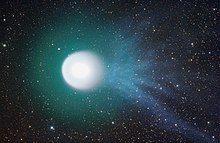
showing blue ion tail on right
**************************** ***************************************************************************************************************************************

 False color DMSP image looking down from


An Aurora
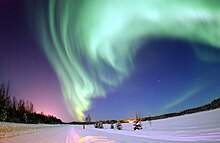
An Aurora is a flickering light caused by the sun's radiation, usually found near the poles. They come in red, green and occasionally blue, and can sometimes resemble fire. In fact, the Roman Emperor Tiberius thought a city was on fire, so he sent fire engines to that city. The city on fire was actually a city against a backdrop of a red aurora.
An aurora can happen in the Arctic, around the North Pole (Aurora borealis - Dawn of the North - here it is also called the Northern Lights) or in the Antarctic around the South Pole (Aurora australis - Dawn of the South). An aurora can often be seen for a long way, many hundreds ofkilometers or miles.
Auroras can only be visible at night because their light is not as strong as the light of day. However they do happen during the day as well.
Aurora happens when the Sun sends off stuff we call particles to the empty space. These particles are charged, which means they have lots of electricity. These particles flying in space are called "solar wind". Sometimes solar wind hits Earth. Earth has a protection shield of energy around it. This is called the "magnetic field". The magnetic field wards off solar wind. At the cold area (polar area) magnetic field is less powerful, and it can not protect Earth from the solar wind. There the particles of the solar wind hit the particles in the air. When they hit the electricity gets away and we see that as light. An aurora can also happen in a CME- coronal mass ejection,when the charged particles rip through the electromagnetic field because of their power.
A group of people called the Sami people who live in Sweden, Norway and Finland think that an Aurora is a tail of a Fox.

850 km altitude showing discrete aurora (yellow)
north of Scandinavia. Clouds and foare blue.


